B&Q / Kingfisher 2012–2020 UI Specialist → Lead Designer

B&Q eCommerce Transformation

Eleven years of continuous evolution—two major platform transformations that scaled B&Q's digital channel from a small operation to a core revenue driver.

Revenue growth multiple
70x
Revenue Growth
Weekly revenue achieved
£14M
Weekly Revenue
Number of major transformations
2
Major Transformations
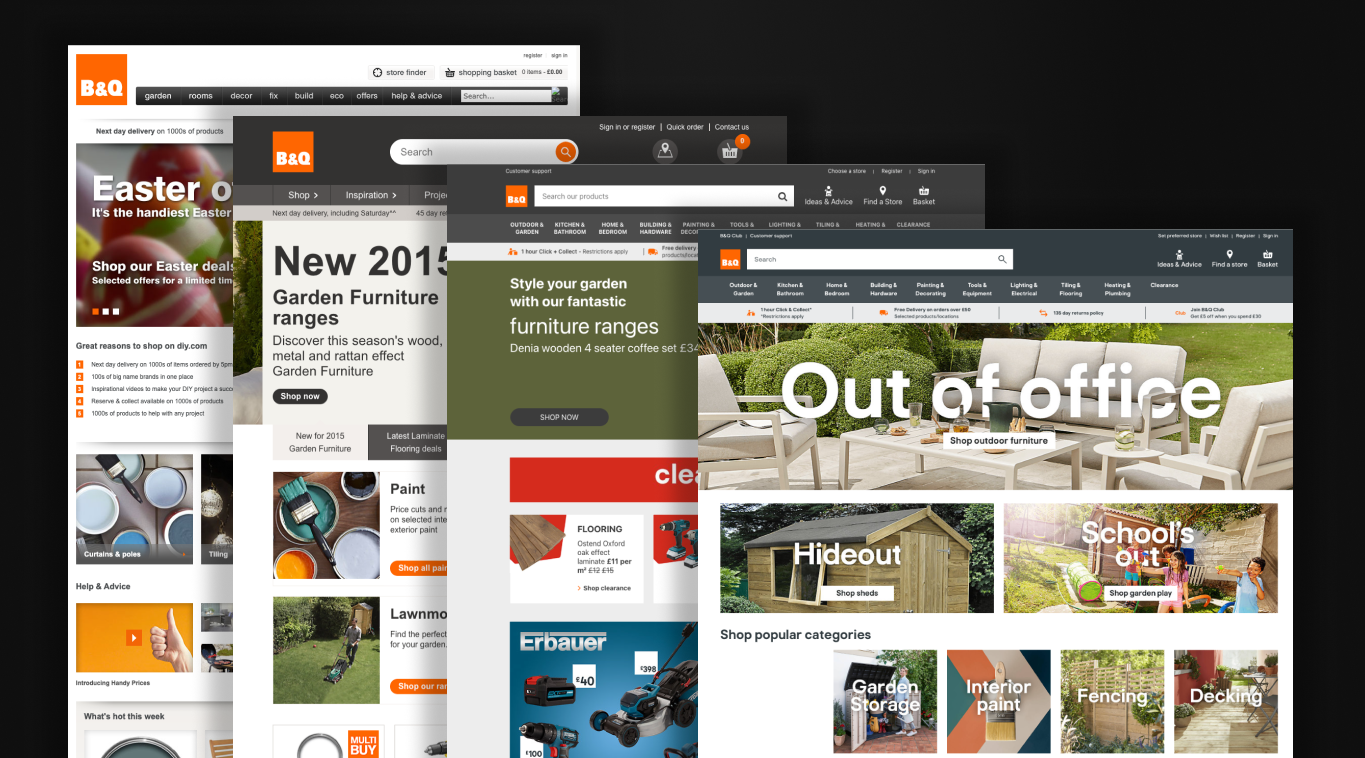
Image showing 4 webpage iterations of the diy.com website over the years
B&Q.com Evolution - Platform progression across two major transformations

From afterthought to core channel

Business Problem

When I joined B&Q in 2012, eCommerce was an afterthought. The website existed, but it was slow, difficult to navigate, and generated modest revenue compared to the store network:

  • £200k weekly revenue—a rounding error for a £4B business
  • Legacy platform with severe technical limitations
  • No mobile experience in an increasingly mobile-first market
  • Product discovery was painful—40,000+ SKUs poorly organised

User Problem

DIY customers have complex needs. They're often mid-project, researching solutions to problems they don't fully understand, and need guidance not just products:

  • Couldn't find products without knowing exact terminology
  • No help understanding what they actually needed for a project
  • Poor imagery made it hard to judge product suitability
  • Stock availability was unreliable—wasted trips to stores

Eleven years of evolution

This wasn't a single project—it was sustained transformation over eight years, through two major platform changes and countless iterative improvements. My role grew alongside the channel.

  • 2012

    Joining as Lead UI Specialist

    Focused on visual design improvements and establishing basic UX patterns within the existing platform constraints.

  • 2014

    First Major Replatform

    Complete redesign on new platform. Responsive design, improved navigation, better product discovery.

  • 2016

    Promoted to UX and Development Lead in B&Q's parent company, Kingfisher

    Took ownership of end-to-end customer experience. Introduced user research practices and data-driven design.

  • 2018

    Second Transformation

    Headless commerce architecture, performance focus, personalisation, and omnichannel integration.

  • 2020

    COVID Acceleration

    Rapid scaling to handle unprecedented demand. Click & Collect became critical infrastructure.

  • 2022

    Marketplace

    Integration of a marketplace into the B&Q ECommerce platform, to increase choice for customers

Continuous improvement

Page-Level Optimisation

Rather than big-bang redesigns, we continuously optimised key pages based on data and user research. Each page evolved through multiple iterations:

  • Homepage: Evolved from static promotional grid to personalised, seasonally-aware entry point
  • Product pages: Enhanced imagery, clearer specifications, improved stock visibility
  • Category pages: Better filtering, project-based navigation alongside traditional browse
  • Checkout: Streamlined flow, reduced form fields, guest checkout improvements
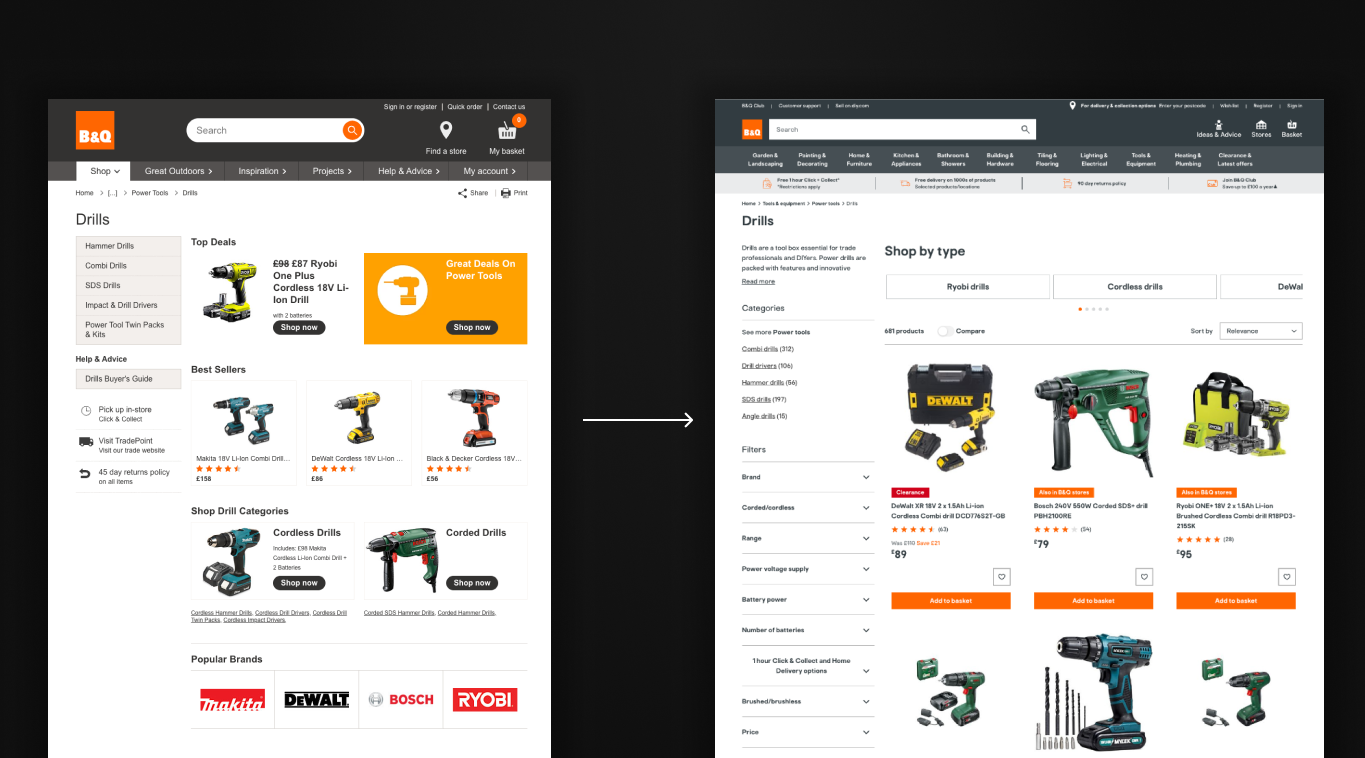
An image showing representation of how a Product Listing page changed over the years
Page Evolution - Homepage, product page, and checkout iterations

Service & Fulfilment Improvements

The website wasn't just about browsing—it was increasingly about services that bridged online and in-store experiences:

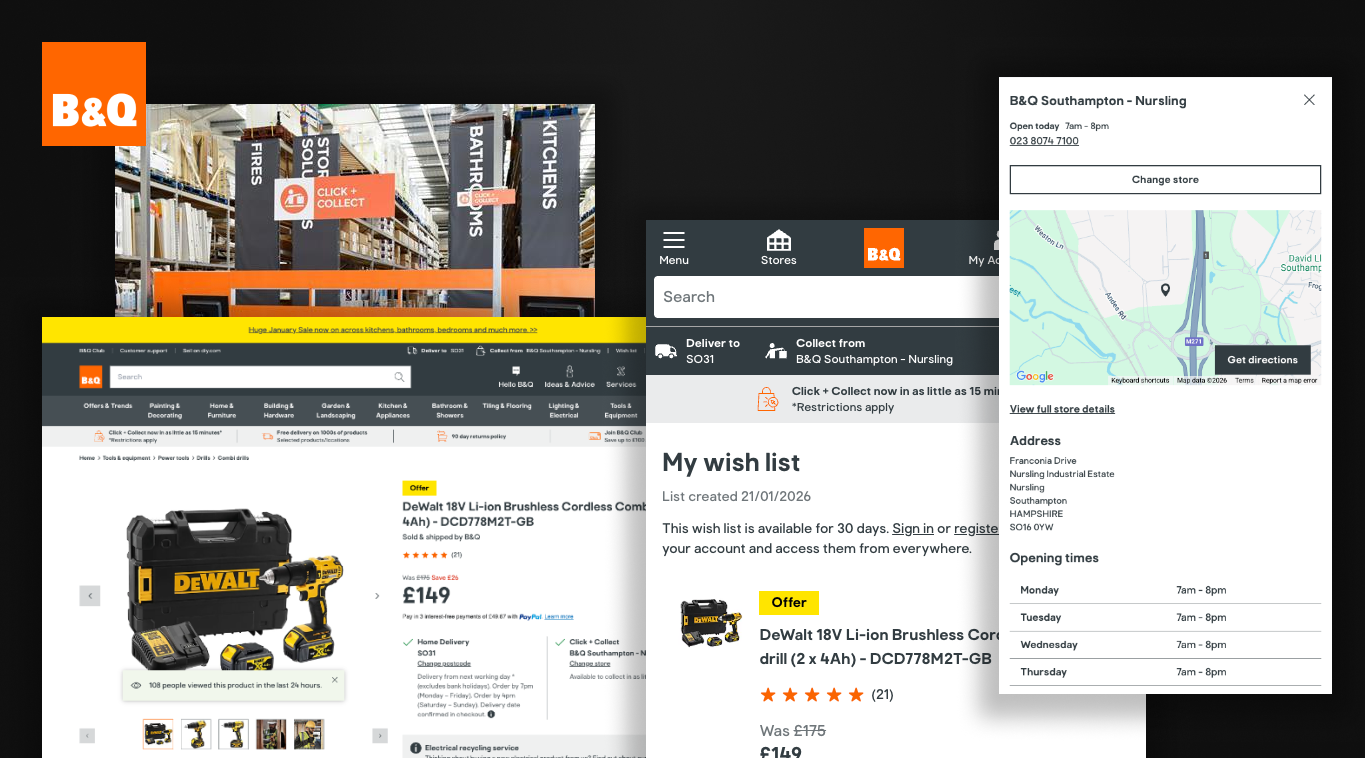
  • Click & Collect: From basic reservation to timed slots, express collection, and real-time readiness notifications
  • Wish lists: Save for later functionality that persisted across sessions and devices
  • Delivery options: Clearer communication of delivery windows, tracking integration
  • Store services: Online booking for kitchen design, tool hire, and timber cutting
An image showing the B&Q logo, a picture of the click and collect desk from a B&Q store, as well as various screenshots of the website showing a product page, wish list and store details page
Services & Fulfilment - Click & Collect flow, wish lists, store services

Behavioural Psychology & Trust Signals

DIY purchases often involve uncertainty—"Will this fit? Is this the right product? Can I actually do this?" We applied behavioural psychology principles to build confidence throughout key journeys:

  • Social proof: Reviews, ratings, and "customers also bought" recommendations
  • Scarcity & urgency: Honest stock levels, delivery cut-off times
  • Authority signals: Expert advice content, how-to guides linked from product pages
  • Risk reduction: Clear returns policy, satisfaction guarantees prominently displayed

Omnichannel Integration

B&Q customers move fluidly between channels—research online, buy in-store, or vice versa. We built features that acknowledged this reality: real-time stock levels, store aisle locations, and saved baskets that persisted across channels.


Performance Obsession

DIY customers are often in cluttered environments—garages, sheds, building sites—with poor connectivity. Every 100ms mattered. We treated performance as a feature, not a technical concern.

Sustained, compounding growth

The results weren't from a single launch—they compounded over years of continuous improvement, two platform transformations, and relentless focus on customer needs.

Business Impact

  • £200k→£14M Weekly revenue growth

    70x increase over eight years, making digital a core revenue channel.

  • 40% Click & Collect share

    Omnichannel strategy drove store traffic while improving convenience.

  • +34% Conversion rate

    Cumulative improvement across both platform transformations.

User Impact

  • +23% Search-to-basket

    Project-based navigation helped customers find what they actually needed.

  • 1.8s Page load time

    Down from 4.2s—critical for customers in poor connectivity environments.

  • +18 NPS improvement

    Customer satisfaction with the digital experience improved significantly.

What I learned

  • Transformation is continuous

    There was no finish line. Each improvement revealed the next opportunity. Sustained attention beats big-bang launches.

  • Performance is a feature

    Speed isn't a technical metric—it's user experience. The performance work probably drove as much conversion as the design work.

  • Meet customers where they are

    DIY customers aren't "online shoppers" or "store shoppers"—they're both, sometimes in the same hour. Design for the journey, not the channel.